Not three separate catalogues, but three moments
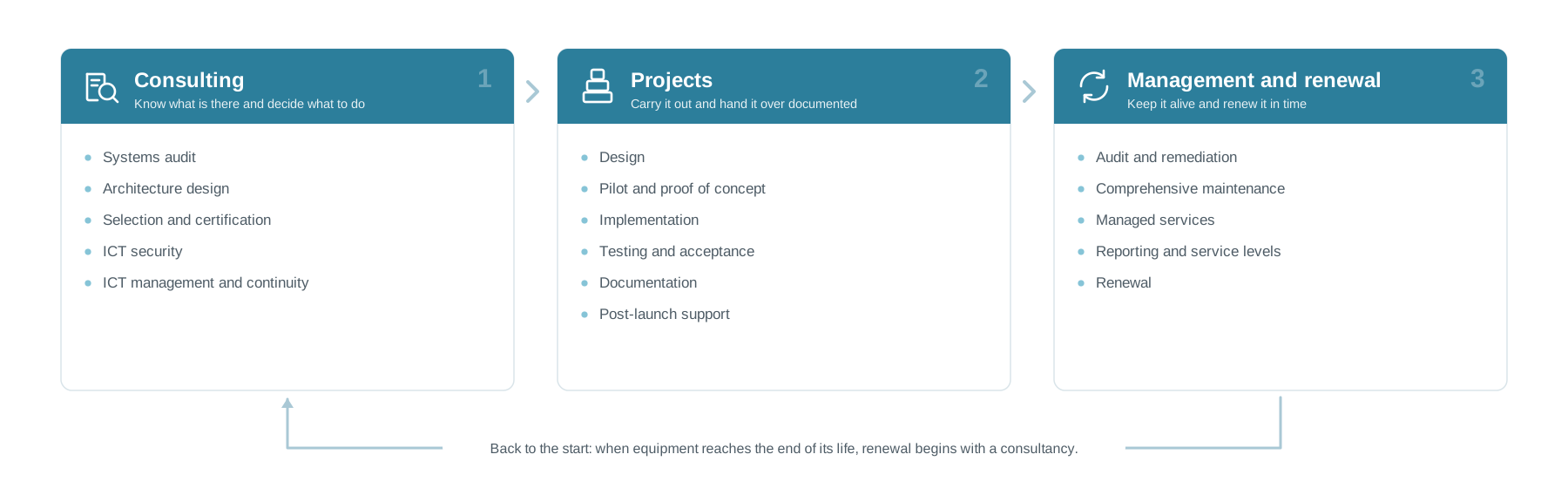
Almost everything we are asked to do follows the same path, even if each client comes in at a different point.
First you need to know what is there and decide what to do. That is consulting: looking at the installation, measuring it, comparing alternatives and putting in writing what makes sense and in what order. Without that step, whatever comes next is done blind.
Then you need to carry it out. That is the project: detailed design, testing it in a pilot, implementing it in an agreed window, passing tests that get signed off and handing it over documented.
And then someone has to keep it alive, which is where most of the time goes. That is management: day-to-day operations, reports, service levels and tracking the end of support of every piece of equipment.
The interesting part is that the end links back to the beginning. When a piece of equipment reaches the end of its useful life, renewal starts again with a consultancy. That is why we work across all three services: because whoever only does one part ends up delivering something that does not hold up, or maintaining something that should never have been set up that way.
If you do not know where to start
"I need to invest and I don't know in what." Consulting. A scoped audit gives you a reliable picture and a list prioritised by risk.
"I know what I want to set up and I need someone to do it." Projects. With project management, an agreed window and documented handover.
"It works, but nobody is looking after it." Management and renewal. Someone checks every day and tells you with numbers how it is going.
"I've been asked to prove this is secure." Consulting, specifically the ICT security block: vulnerabilities, ethical hacking and risk analysis.
"I have equipment whose support is running out." Management and renewal. And, if the replacement is a big one, a project after it.
If you are torn between two, call us and we will sort it out in one conversation. It is free and is usually cleared up in twenty minutes.